
You picked a great topic with a lot of local flavor and history potential. I’ll draft a roughly 1,500-word article and include 6 comma-separated tags at the end, without hashtags, as requested.
The Evolution of Outdoor Basketball in Denver: From Streetball to City Parks
Basketball has always been more than a game in Denver. On blacktop courts from Five Points to Park Hill, it has been a language, a proving ground, and a bridge between neighborhoods. Long before sleek recreation centers and refurbished city parks, outdoor hoops in Denver were raw, improvised, and deeply local. The evolution from gritty streetball scenes to today’s organized, community-centered park culture tells a story about how the city itself has changed—and how the love of the game managed to stay the same.
Early Roots: Hoops on the Blacktop
Denver’s outdoor basketball culture traces its roots to mid-20th century neighborhood courts, schoolyards, and improvised setups in alleys and vacant lots. Back then, the game was less about structured leagues and more about whoever showed up with a ball. A bent rim bolted onto a garage, two chalk lines on the pavement, and suddenly the block had a court.
In neighborhoods like Five Points, historically known as the “Harlem of the West,” basketball became an extension of the jazz and culture scene that defined the area. Kids and teenagers played pick-up games into the night, often under dim streetlights or makeshift lighting. There were no referees and no programs; the rules were enforced by pride, pecking order, and the unwritten codes of streetball.
These early years forged the identity of Denver basketball. Players developed tough, creative styles that reflected their surroundings. You had to learn how to play through contact, adjust to slanted pavement, and deal with unpredictable rims. Those conditions didn’t just produce solid players—they produced competitors.
Streetball Culture: Style, Respect, and Reputation
As basketball grew nationally through the 1970s and 1980s, Denver’s outdoor game took on a more defined streetball culture. Streetball meant more than just playing outside; it meant style, attitude, and community.
On courts across the city, reputations were built one possession at a time. If you were known for locking people up on defense at City Park, or for your handle at a schoolyard in Montbello, word traveled. You didn’t need social media—your name moved by word of mouth, from one game to the next.
Streetball in Denver had a few defining traits:
- Physical play was the norm, not the exception.
- Fouls were debated loudly and settled quickly—or you lost your spot.
- Winners stayed on; losers waited, sometimes for a long time.
- Flash mattered, but production mattered more.
Creativity in streetball was a self-taught art. Players mimicked moves they saw on TV, in college and NBA games, then adapted them to local courts. No coach was diagramming crossovers or step-backs; kids learned by trial and error, cheered on—or roasted—by their peers.
This phase also reflected the realities of the city. For many young people, outdoor courts were accessible when private gyms and membership-based facilities were not. A city park court cost nothing. All you needed was the courage to step on and ask, “Who’s got next?”
The Role of Neighborhood Courts
While some cities are associated with a single iconic outdoor court, Denver’s culture has always been more decentralized. Multiple pockets of the city created their own mini-ecosystems of competition and identity.
Neighborhood courts often had distinct reputations:
- Some were known as “run all day” spots where games started early and ended only when it got dark.
- Others were considered tough courts where you had to earn every bucket and every ounce of respect.
- Certain parks became gathering spots in the summer, tying together music, barbecues, and hoops.
Beyond competition, these spaces served an important social function. Older players mentored younger ones almost by default. Younger kids sat on the side, watching runs and absorbing not just skills, but values: resilience, accountability, and the importance of showing up.
These courts also operated as community barometers. When a rim went missing or a backboard cracked and stayed unfixed, it signaled neglect. When a court got fresh nets, newly painted lines, or added lights, it sent the message that the neighborhood mattered.
City Involvement: From Informal to Intentional
Over time, Denver’s local government and parks department began to recognize how central basketball courts were to neighborhood life. As the city grew and diversified, outdoor recreation became a policy priority, not just an afterthought. This marked the beginning of a shift from informal streetball to more intentional, city-supported spaces.
Key changes started appearing:
- Renovated park courts with smoother surfaces and sturdier rims.
- Better lighting, allowing safer evening play.
- Open outdoor courts added to new and existing parks in developing areas.
- Collaboration with community groups to keep facilities in good condition.
The city’s investment brought stability and visibility. Outdoor basketball was no longer something that just happened wherever someone screwed a rim into a wall; it was being formally built into neighborhoods. This infrastructure helped protect the culture, even as Denver experienced rapid growth and redevelopment.
At the same time, increased structure brought new dynamics. When parks scheduled clinics, camps, and organized play, they opened doors to younger kids and families who might have been hesitant to jump straight into intense pick-up runs. Outdoor basketball became more inclusive, with clearer opportunities for all ages and skill levels.
The Influence of High School, College, and the Nuggets
As Denver’s organized basketball scene rose in profile, outdoor courts reflected that energy. High school hoops in Colorado, and Denver programs in particular, started producing more college-level talent. As local players earned scholarships and reputations, their roots on outdoor courts became part of their story.
The Denver Nuggets and, more broadly, the NBA also left a mark. When the Nuggets became more competitive and the league itself exploded in global popularity, kids across the city wore jerseys and tried to emulate their favorite stars on outdoor courts. Signature moves—like step-back threes, euro-steps, or crafty finishes at the rim—showed up quickly in park games.
Local programs, AAU teams, and trainers began using outdoor spaces alongside indoor gyms. Summer workouts often moved outside, where players got used to wind, sun, and the familiar give of asphalt or concrete. The line between “street” and “organized” ball blurred; many players comfortably navigated both worlds.
Community and school coaches also recognized that park courts were informal scouting and relationship-building grounds. Showing up at local runs wasn’t just about recruiting talent; it was about understanding the environment their players came from and building trust.
Modern City Parks: Organized, Inclusive, and Still Competitive
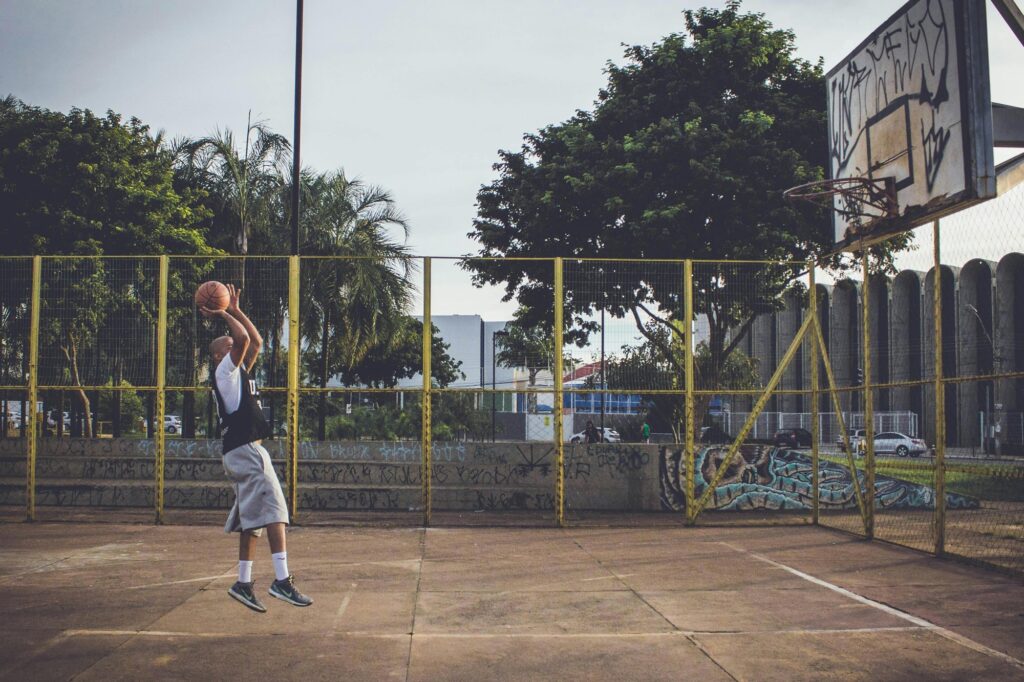
Today, outdoor basketball in Denver has grown into a hybrid culture where old-school streetball and modern park infrastructure coexist. You can still find intense, winner-stays-on runs, but you will also see:
- Youth clinics teaching fundamentals on the same courts.
- Mixed-age games where teenagers share the floor with adults.
- Women’s and co-ed pick-up runs gaining visibility and support.
- Families using courts as part of a broader day at the park.
City parks now often feature multiple courts, clear striping, and breakaway rims. Some host tournaments, three-on-three events, or charity games that bring together players from different parts of the city. What started as isolated neighborhood scenes has evolved into a more connected outdoor basketball network.
Technology has also changed how people experience outdoor hoops. Instead of word-of-mouth only, players use group chats and social media to organize runs, post highlight clips, and announce events. Yet when the ball goes up, the essentials stay the same: call your own fouls, respect the game, and let the court decide.
Challenges: Space, Growth, and Access
With Denver’s population growth and development pressure, outdoor basketball faces new challenges that mirror the city’s broader struggles.
Some issues include:
- Courts near rapidly developing areas feeling squeezed or repurposed.
- Noise or crowd complaints from nearby residents who don’t share the same connection to the game.
- Wear and tear outpacing maintenance in high-use parks.
- Transportation gaps making it harder for some youth to reach the best facilities.
Balancing growth with preservation is an ongoing conversation. Many longtime residents advocate strongly for protecting and improving outdoor courts, seeing them as vital to youth development, crime prevention, and community cohesion. In this context, basketball courts become part of a larger debate about who the city is for—and whose history is honored in how public spaces are designed.
Community Ownership and the Future
Despite these pressures, outdoor basketball in Denver remains resilient because it is rooted in community ownership. You see it in the way players bring their own nets and tie them up when the old ones are gone. You see it when someone shovels snow or sweeps dust and leaves before a game. You see it in local groups raising funds or partnering with nonprofits to restore or upgrade courts.
The future of outdoor basketball in Denver will likely revolve around a few key themes:
- Preservation of legacy courts. Protecting historically significant courts that have anchored neighborhoods for decades.
- Inclusive programming. Ensuring girls, women, and younger kids continue to find welcoming spaces in a culture historically dominated by adult men.
- Smart design. Building and renovating courts with lighting, seating, shade, and safe surroundings to encourage regular, all-ages use.
- Partnerships. Connecting city agencies, schools, nonprofits, and local businesses to keep courts funded, maintained, and vibrant.
Outdoor basketball is one of the few spaces where strangers can show up, say almost nothing, and still leave with a shared experience and a sense of connection. In a city that is changing quickly, that kind of unplanned community is invaluable.
From Street Corners to City Parks
The story of outdoor basketball in Denver is, in many ways, the story of Denver itself. It began in tight-knit neighborhoods where kids nailed rims to walls and played until the streetlights came on. It matured into a citywide culture that blends unfiltered streetball with polished park facilities, youth development, and organized events.
Through all the phases—from makeshift courts to modern parks—the constants have been competition, creativity, and community. Players still show up with the same goal: to prove themselves, to get better, and to be part of something that stretches beyond one game or one summer.
As Denver continues to grow, the courts scattered across its parks and neighborhoods will keep telling a quiet but powerful story. They show how a simple game played on outdoor rims can help shape identity, preserve community ties, and give every new generation a place to belong.